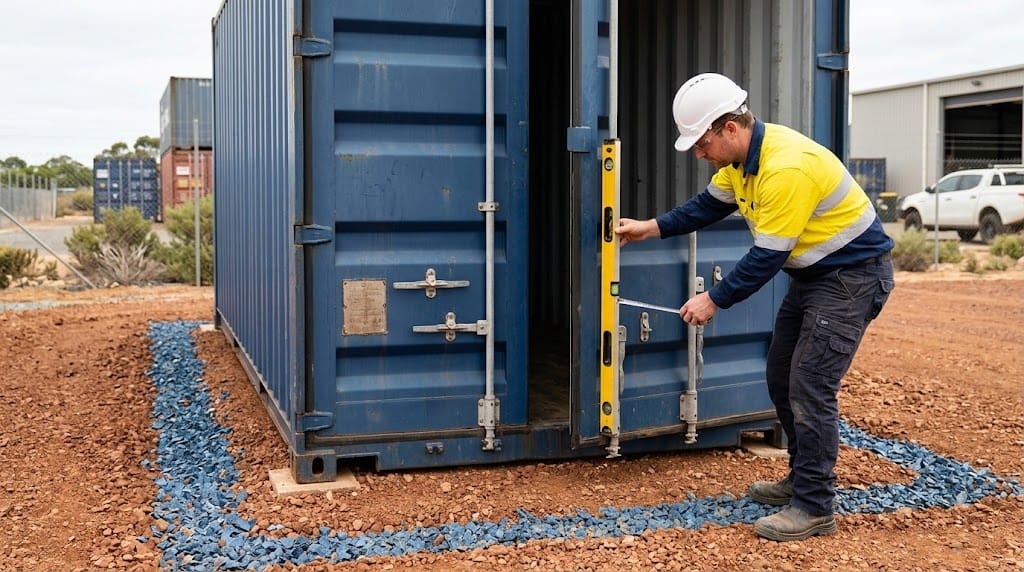
A container can look correctly placed from a distance and still behave badly at the doors. One door may feel tight, the locking bars may resist movement or the frame may no longer feel square.
Level ground for shipping containers matters because the box needs stable support after it is unloaded. The placement surface also has to cope with the site, the container load and normal weather conditions.
Container base preparation should therefore be treated as a support and stability task, not as a cosmetic levelling exercise. If the cause of poor door operation is unclear, stop forcing the door and assess the support first.
Start With What the Container Is Doing
Door Problems Can Point to Uneven Support
A shipping container is a rigid steel structure, but its frame can still respond to uneven support.
The client’s delivery and placement guidance requires level ground and prefers solid ground over soft sandy surfaces. That is relevant after unloading as well as during truck setup.
If the container is visibly leaning or one corner has settled, the base needs attention before the door is repeatedly forced.
Rule Out Damage and Hardware Issues Too
Not every stiff door is caused by the ground.
Door seals, hinges, locking gear, corrosion, previous impact or container damage can also affect operation. Check the condition of the door and frame rather than assuming levelling will solve every problem.
The current anti-vandal container door page even notes that movement can occur when a container is positioned on an uneven surface. That supports the need to consider frame position, but it does not create a universal levelling method.
Check the Support Surface
Why Firm and Level Ground Matters
Firm support reduces the chance of the container settling unpredictably after placement.
For container base preparation, look for soft patches, erosion, standing water, loose fill and obvious changes in level across the footprint.
The goal is a stable support condition appropriate to the actual site. This is more useful than chasing a generic online tolerance that may not apply to the container or intended use.
Keep Drainage and Settlement in Mind
A base can be level on delivery day and change later.
Rain, vehicle traffic, soft soil and poor drainage can alter the support beneath a container. Recheck the placement if doors become harder to operate after weather or site works.
Do not treat door resistance as something to overcome with extra force. A change in operation can be a reason to inspect the base and container condition.
Prepare the Base Without Inventing a Formula
Avoid One-Size-Fits-All Block Layouts
Online advice often gives fixed block spacing or footing dimensions without knowing the site.
The client website does not publish a universal support layout. This article therefore does not prescribe concrete thickness, pier spacing or improvised levelling pack dimensions.
For permanent work, modified containers or sites with poor soil, use appropriately qualified advice for the base and any structural requirements.
Use Site-Specific Advice for Permanent Works
A short-term storage unit and a container incorporated into a larger project are not the same installation.
An on-site placement assessment can help when the issue is access, fit or the most suitable position. Structural foundation design may still need a separate competent professional.
This separation prevents a placement discussion from being misrepresented as engineering certification.
Recheck the Container After Placement
Watch for Changes After Settling
After a container has been placed, check that:
- Doors move without abnormal force
- Locking bars align normally
- The container has not visibly settled at one corner
- Water is not pooling around the support area
- Nearby earthworks have not undermined the base
These checks are observational. They do not replace a structural assessment where one is needed.
Use Professional Assessment When the Cause Is Unclear
If the container is damaged, modified or repeatedly shifting, avoid repeated DIY levelling attempts.
Around this point, Container Refrigeration may be relevant for container condition, placement and product discussions. The current container sales range also shows the variety of container types that may have different project uses.
The base still needs to suit the real container, load and site rather than the category name alone.
FAQs
Can Uneven Ground Make Container Doors Hard to Open?
Yes, uneven support can contribute to frame movement that affects door operation.
It is not the only possible cause. Inspect the door hardware and container condition as well.
Does a Container Need to Be Perfectly Level?
The client transport guidance states that the ground must be level.
For practical placement, use a stable, level support condition and seek site-specific advice if the project has structural or permanent-installation requirements.
Can I Level a Container With Random Timber Offcuts?
This article does not recommend improvised packing materials or a DIY levelling method.
The support system should be suitable for the load, site and intended use.
Is a Concrete Slab Always Required?
No universal slab requirement is published on the current client website.
The right base depends on the project. Permanent or structural applications should use site-specific professional advice.
Conclusion
Level ground for shipping containers supports better placement and can reduce problems caused by uneven support. Container base preparation should focus on stability, drainage and the actual site rather than a generic block pattern.
If door alignment or ground conditions are uncertain, call (08) 9335 6299 or request a site assessment before the container is permanently positioned.