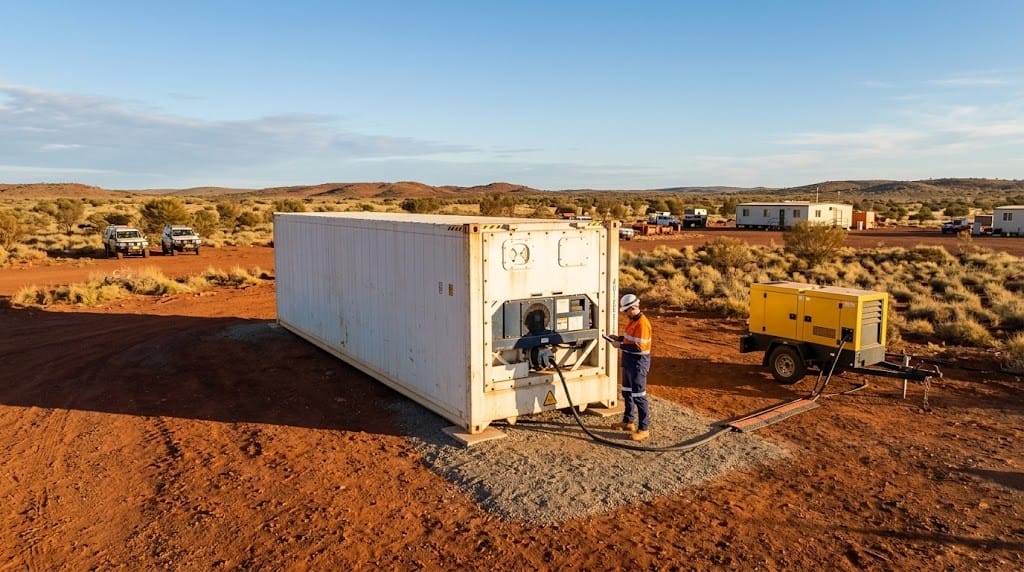
Remote cold storage can fail before it starts if the power source is treated as an afterthought. A refrigerated container may reach the site, yet still be unusable if the available supply does not match the exact unit.
Refrigerated container power requirements depend on the container and refrigeration configuration. The safe approach is to identify the actual unit first, then match phase, voltage, amperage, connection method and backup power around it.
Powering reefers off grid adds another layer. A remote site needs a planned energy source and qualified electrical confirmation, not an improvised connection based on plug appearance.
Identify the Exact Refrigerated Unit First
Why the Category Matters
Refrigerated containers are not electrically interchangeable.
The current single-phase refrigerated range and three-phase range are separate categories because they are designed around different supply arrangements.
Start with the storage task and the exact container being considered. Do not select a generator, cable or adaptor until that unit is known.
Why the Product Plate and Current Specification Still Matter
Category information is useful for planning, but the exact unit remains the final reference.
Equipment can vary by model, modification and refrigeration machinery. Confirm the current specification before electrical work, transport or site setup.
This is especially important on remote sites where there may be no easy alternative supply if the planned connection is wrong.
Separate Single-Phase and Three-Phase Power
What the Current Single-Phase Range States
The current single-phase category states that its listed units connect to a 240 V, 15 A supply.
That is useful when reviewing refrigerated container power requirements, but it should not be converted into a claim that every refrigerated container uses household power.
The supply, outlet, protection and cable arrangement still need to suit the exact equipment and site.
What the Current Three-Phase Range States
The current three-phase refrigerated containers page states a 32 A, 415 V supply for the category.
Three-phase power is a different site requirement from single-phase power. Do not assume a site has the correct outlet simply because other industrial equipment operates there.
Where the switchboard, protection or connection is uncertain, use a qualified electrician to confirm the supply.
Plan Remote Power Without Guessing
When a Reefer Generator May Be Relevant
A fixed grid connection is not always available at a remote site.
The current reefer generator range is specifically presented as three-phase generator support for refrigerated containers used in remote, transport and stationary applications.
That makes generator power a legitimate option to investigate for certain three-phase reefer setups. It does not mean any generator can power any refrigerated container.
Why Generator Compatibility Must Be Confirmed
The Carrier RG15 generator is one named clip-on generator in the current catalogue.
It should be treated as a specific product, not a universal answer for powering reefers off grid. Its output, connection and intended reefer compatibility must be matched to the equipment being used.
Do not choose backup power from engine size, plug shape or a general wattage estimate alone.
Check Leads, Adaptors and Electrical Protection
Use the Correct Lead for the Actual Unit
Cable length and connector type are part of the power plan.
The current container extension leads category includes single-phase leads, three-phase leads and specialised adaptors. The product range does not remove the need to confirm compatibility.
Avoid joining unsuitable leads or creating an improvised connection. Electrical installation and protection should be assessed by a qualified person where there is any uncertainty.
Do Not Treat an Adaptor as a Power Conversion Shortcut
An adaptor changes a connection format. It does not automatically change an incompatible power supply into a compatible one.
The listed three-phase shipping adaptor is a defined product for a specific 32 A three-phase connection arrangement.
That product should only be considered when the source, plug, socket, phase and equipment requirements match. It is not evidence that every international reefer can connect to every Australian site.
Build a Remote-Site Power Brief
Include Operating and Site Information
Before selecting equipment, prepare a short brief that covers:
- Exact refrigerated container or model being considered
- Required storage task
- Available phase and electrical supply
- Existing socket and switchboard details
- Distance from the supply point to the proposed container position
- Whether generator support is required
- Expected operating period
- Site access for servicing and refuelling
- Any local electrical or site rules
Around this stage, Container Refrigeration can review the container and available product pathways. Electrical suitability should still be confirmed for the actual site.
Plan for Continuity and Service Access
Remote power planning should include what happens if the primary source stops.
For temperature-sensitive storage, continuity planning may involve a generator strategy, alternative equipment or an operational response. The correct approach depends on the stored product and site.
Do not make unsupported claims about runtime, fuel use or temperature recovery. Those figures need product-specific evidence.
FAQs
Can Every Refrigerated Container Run on Single-Phase Power?
No.
The website separates single-phase and three-phase refrigerated containers. Confirm the exact unit before planning the electrical supply.
Can a Solar-Powered Office Container System Run a Reefer?
The current client page for off-grid solar covers office containers, not refrigerated containers.
It should not be used as proof that the same solar configuration can power a reefer. Any solar or battery system for refrigeration would need site-specific electrical and load assessment.
Can I Use a Generator for a Refrigerated Container?
Yes, generator solutions are listed for three-phase reefer applications.
Compatibility still depends on the exact refrigeration unit and generator. Confirm the combination before use.
Should I Change Plugs or Adaptors to Make a Unit Fit?
No DIY electrical alteration should be used to force compatibility.
Confirm the correct phase, voltage, amperage, socket, cable and protection arrangement with qualified electrical advice.
Conclusion
Remote refrigeration works only when the unit and power source are planned together. Confirm the exact reefer first, then match the supply, connection method and backup strategy to that equipment.
For a remote refrigeration project, call (08) 9335 6299 or discuss power requirements before equipment or electrical work is committed.