Western Australia’s vast mining sites, pastoral stations, and remote work camps share a critical challenge: reliable cold storage without grid power. A cattle station far from the nearest town can’t afford a refrigeration failure. Neither can a mine site storing medical supplies in 45°C heat.
Off-grid solar containers WA solve this problem. They combine proven refrigeration technology with renewable energy systems designed for WA’s extreme conditions. The result is continuous solar container refrigeration that operates independently without diesel dependency or grid connection costs.
Why Remote WA Operations Need Solar-Powered Cold Storage
Grid power doesn’t reach most of Western Australia’s working landscape. The state covers 2.5 million square kilometres, but the South West Interconnected System serves a small fraction of that area. Everything beyond the grid line requires alternative power solutions.
Diesel generators have traditionally filled this gap. They’re reliable and well-understood. But diesel also means ongoing fuel deliveries, scheduled maintenance, and vulnerability to supply chain disruptions. For remote stations and mine sites, these logistics costs add up significantly over the life of the operation.
Solar powered container Perth and remote WA systems eliminate fuel costs once installed. Properly sized solar arrays generate electricity at zero marginal cost. Battery banks store excess generation for night-time operation and cloudy periods.
The economics shift dramatically at remote sites. Grid connection infrastructure costs increase substantially with distance from existing supply. Off-grid refrigeration WA solar systems typically achieve payback well within their operational life compared to ongoing diesel costs.
How Solar-Powered Refrigerated Containers Actually Work
A solar powered container Perth or remote installation integrates three core systems: the refrigeration unit, the solar generation array, and the battery storage bank. Each component must be correctly sized and matched to the others.
The refrigeration unit itself is identical to grid-powered models. Most remote WA installations use Carrier or Thermo King units rated for -25°C to +25°C operation. Units are selected based on container size, ambient temperature at the site, and required setpoint temperature.
Solar panels generate DC electricity during daylight hours. WA’s solar resource is exceptional – Perth receives an average of 8.8 hours of peak sun per day annually, and the Pilbara and Goldfields regions exceed this. Solar container refrigeration systems in these regions can be sized to build substantial battery reserves during optimal conditions.
Battery banks store excess solar generation for use during non-generating hours. Lithium iron phosphate (LiFePO4) batteries have become the standard for off-grid refrigeration WA remote installations. They offer high cycle counts, operate reliably in elevated temperatures, and require no active cooling.
An inverter converts DC battery power to AC power for the refrigeration unit. Quality inverters deliver pure sine wave output and include built-in charge controllers that manage solar input and battery charging.
Sizing Solar Systems for WA’s Climate Conditions
A solar powered container Perth or regional system must be sized to meet the refrigeration unit’s daily power demand reliably – including during winter months and extended cloudy periods.
Remote cold storage Western Australia solar installers typically size arrays to generate significantly more than average daily consumption. This oversizing ensures adequate generation during lower-yield winter months and builds battery reserves during optimal conditions.
Battery banks are sized to provide multiple days of autonomous operation without solar input. The exact capacity depends on the daily refrigeration load and the acceptable risk of needing generator backup during worst-case weather periods.
Key factors affecting off-grid solar container WA system sizing:
- Container size – a 20-foot unit requires more daily power than a 10-foot unit
- Temperature setpoint – maintaining -20°C draws significantly more power than maintaining +4°C
- Ambient temperature – Pilbara sites work refrigeration units harder than cooler southern locations
- Door opening frequency – high-traffic access drives up power consumption
- Site solar resource – northern WA locations generate more power than southern sites
Always engage a licensed solar installer to calculate system requirements based on your specific container, location, and usage patterns before purchasing components.
Refrigeration Unit Selection for Solar Systems
Selecting the right refrigeration unit is critical for off-grid solar container WA performance. The unit must operate reliably on inverter-generated power and handle the ambient temperatures at your site.
The Carrier Primeline remote unit is designed for high ambient temperature performance and operates reliably on quality pure sine wave inverter power – making it a common choice for solar container refrigeration installations across WA’s remote regions.
For small-scale off-grid refrigeration WA applications with modest cold storage needs, a mini off-grid cool room requires a smaller solar array and battery bank than a full-size container – reducing upfront system costs significantly for pastoral stations with limited cold storage requirements.
Power Requirements and System Configuration
Single-phase remote refrigeration units suit most off-grid refrigeration WA remote installations. They operate on standard 240V AC power and match the output of typical solar inverters. Diesel-free refrigeration using single-phase containers is simpler and lower-cost than three-phase alternatives for most single-container applications.
Three-phase units require more complex solar container refrigeration configurations. Three-phase systems make sense for larger off-grid solar container WA installations with multiple containers or higher cooling capacity requirements.
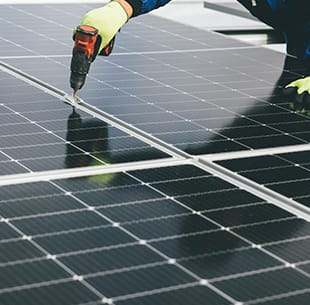
Ground-mounted solar arrays are standard in remote WA installations. Roof-mounting on containers is possible but complicates maintenance and can reduce airflow around the refrigeration unit. Ground arrays also allow easy angle adjustment for seasonal optimisation of solar powered container Perth and regional installations.
Backup Power and Redundancy Options
Container Refrigeration supplies refrigerated containers suited to off-grid solar container WA installations across the Pilbara, Goldfields, and Kimberley regions. We coordinate container delivery and work with your solar installer to ensure the refrigeration unit’s power requirements are correctly matched to the solar system design.
No power system is 100% reliable. Professional off-grid refrigeration WA installations include backup provisions for extended low-solar periods or component failures.
The simplest backup is a diesel generator sized to run the refrigeration unit directly. The generator remains idle during normal solar container refrigeration operation but provides emergency power if battery reserves deplete below a safe threshold.
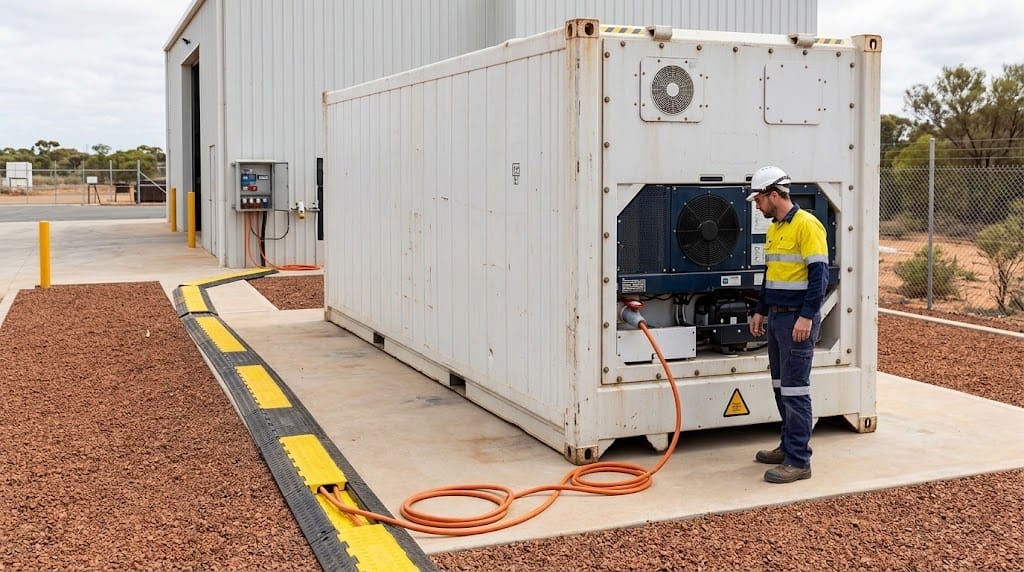
Our backup refrigeration power generator suits off-grid solar container WA installations using three-phase refrigeration units. It provides reliable backup power and can recharge battery banks when emergency top-up is needed during extended low-solar periods.
A power connection adaptor kit ensures your backup generator connects correctly to your off-grid solar container WA refrigeration unit – preventing compatibility issues during emergency power situations.
Installation Requirements for Remote Sites
Site preparation determines system reliability. Solar arrays require stable ground with clear sun exposure. In WA’s red dirt country, this typically means compacted gravel pads or concrete footings for panel frames.
Off-grid solar container WA container placement must allow adequate airflow around the refrigeration unit. The unit’s condenser requires clear space and should face away from prevailing winds that carry dust.
Electrical components require weatherproof housing. Battery banks and inverters are typically installed in separate lockable enclosures with ventilation. WA’s temperature extremes require thermal management of battery storage.
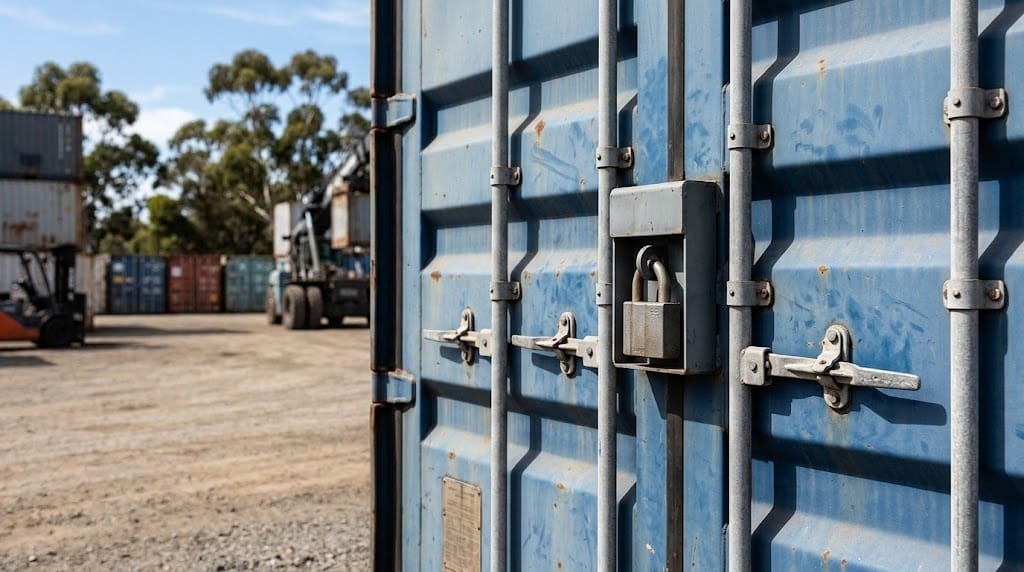
Security matters at remote off-grid solar container WA sites. Solar panels, batteries, and refrigerated containers all represent valuable assets. Most installations include lockable fencing and cellular monitoring systems.
Our remote site power lead kit for off-grid solar container WA installations provides rated leads for connecting containers to inverter output points across larger remote site footprints.
Monitoring and Remote Management
Remote off-grid refrigeration WA installations benefit significantly from monitoring systems that provide visibility without requiring physical site visits.
Our remote container monitoring service provides ongoing environmental oversight for solar container refrigeration systems – particularly valuable for unmanned remote cold storage Western Australia deployments.
Real-time alerts mean pastoral station managers and mine site supervisors receive notification of system issues on their phone, allowing rapid response before temperature excursions damage stored products.
For off-grid solar container WA sites where high-value produce, pharmaceuticals, or equipment is stored, secure container door fittings protect your remote cold storage from unauthorised access between site visits.
Maintenance and Long-Term Reliability
Solar powered container Perth and remote systems require less maintenance than diesel alternatives. Regular inspections should cover panel cleaning, connection tightness checks, and battery voltage monitoring.
WA’s red dust is the primary maintenance challenge for solar container refrigeration systems. Dust accumulation on solar panels reduces output measurably if left unchecked. Most remote operators schedule panel cleaning quarterly, or after dust storms.
Refrigeration units require standard maintenance regardless of power source. This includes annual refrigerant checks by ARC-licensed technicians, condenser coil cleaning, and door seal inspection.
Our remote refrigeration maintenance service covers scheduled maintenance for off-grid solar container WA refrigeration units – coordinating ARC-licensed technician visits around your remote site’s operational schedule.
If your off-grid solar container WA refrigeration unit needs urgent attention, our 24/7 emergency callout service provides round-the-clock technical support – critical for remote diesel-free refrigeration installations.
Compliance and Safety Standards
Off-grid solar container WA electrical installations in Western Australia must comply with AS/NZS 3000 (Wiring Rules) and AS/NZS 5139 (Electrical Installations – Safety of Battery Systems for Use with Power Conversion Equipment).
Licensed electrical contractors must design and install solar powered container Perth and remote power systems. The contractor lodges a Notice of Completion with Building and Energy WA upon installation completion.
Refrigeration work on off-grid refrigeration WA systems requires ARC licensing. This includes initial installation, refrigerant charging, and any maintenance involving refrigerant handling.
Our container compliance certification ensures the container itself meets structural standards before installation of off-grid solar container WA power and refrigeration systems.
For businesses new to diesel-free refrigeration who want to understand the full range of container options before committing to an off-grid build, our new refrigerated container range provides specifications, power requirements, and insulation ratings for all standard sizes – helping your solar installer size the system accurately.
For remote cold storage Western Australia operations that also need secure on-site office or workshop infrastructure alongside solar-powered cold storage, our container hire options provide flexible access to dry and modified containers delivered to your remote WA site.
For businesses evaluating off-grid solar container WA locations that need a pre-installation site check, our remote site pre-assessment confirms access routes, ground conditions, solar exposure, and power connection requirements before any equipment is ordered.
For remote cold storage Western Australia operators wanting to see the full range of new refrigerated containers before committing to an off-grid build, our new dry shipping containers can be paired with solar-powered refrigeration units to create combined dry and cold storage setups at remote WA sites.
Call (08) 9335 6299 or speak with our specialists to discuss your off-grid refrigeration WA cold storage requirements. We’ll help match the right container and refrigeration unit to your site and usage conditions.