
Field operations demand equipment that survives extremes. The Australian Defence Force operates across deserts where temperatures hit 50°C, tropical zones with high humidity, and remote coastlines battered by salt spray. Standard storage solutions fail under these conditions.
Containers for defence Australia operations deliver three critical capabilities: rapid deployment, environmental protection, and field adaptability. A defence shipping container WA or broader Australia build can be positioned at a forward operating base, connected to power quickly, and maintain precise temperature control for extended periods without constant maintenance.
Why Defence Operations Require Specialised Container Solutions
Military field operations present challenges that civilian storage never encounters. Equipment must survive sandstorms, maintain operation during power interruptions, and function after transport across rough terrain.
Standard commercial containers lack the reinforcement, climate control, and security features defence equipment storage solutions demand. Military shipping containers Australia builds use enhanced coatings and structural specifications that resist corrosion in coastal salt spray environments where standard steel degrades quickly.
Temperature-sensitive supplies create the most critical challenge. Medical vaccines, communications equipment, and other materials degrade in uncontrolled conditions. A defence shipping container WA configured for field hospital cold storage maintains 2°C-8°C storage, preserving medical supplies for field hospitals and forward treatment facilities.
Structural Durability for Extreme Environments
Military-grade container modifications use heavier-gauge steel than standard commercial units. This construction handles the stress of transport across rough terrain and the load requirements of operational deployment.
Reinforced corner castings handle the demands of crane lifting and rough-terrain transport. Each corner casting is designed to support significant vertical load – critical when containers are stacked at temporary bases or lifted into position at remote sites.
Floor systems matter as much as walls. Military shipping containers Australia builds use floors rated for heavy equipment loading – preventing structural failure when teams load generators, water purification systems, or equipment crates.
Insulation quality directly affects whether a refrigerated defence shipping container WA maintains temperature in high ambient heat. Adequate insulation thickness reduces power consumption whilst maintaining stable internal temperatures – important for containers for defence Australia operating on limited generator capacity.
Climate Control Systems Built for Field Conditions
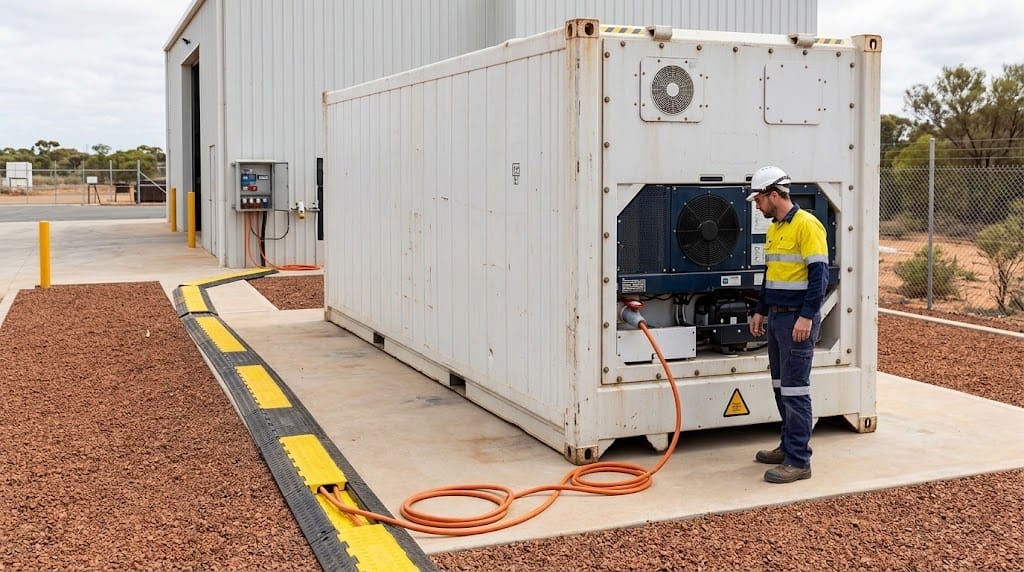
Refrigeration units for defence equipment storage solutions must operate on inconsistent power supplies and survive dust conditions that clog standard cooling systems. The Carrier container refrigeration unit is designed for high ambient temperature performance and suits remote field deployments where conditions exceed standard commercial specifications.
Single-phase field refrigeration units suit forward operating bases with limited power infrastructure. A single-phase unit runs on a standard 15-amp supply from a portable generator, maintaining -25°C to +25°C temperature ranges for field hospital cold storage and general defence equipment storage solutions.
Three-phase systems deliver higher cooling capacity for larger field hospital cold storage facilities. These units handle the thermal demands of frequent door openings in hot climates.
Backup power integration prevents temperature excursions during generator changeovers. Automatic transfer switches maintain cooling during the gap between disconnecting one generator and starting another – protecting medical supplies and temperature-sensitive equipment in containers for defence Australia deployments.
Security Features That Prevent Unauthorised Access
Military-grade container modifications for defence shipping container WA builds must secure equipment of significant operational value. Standard container locks are insufficient for defence applications.
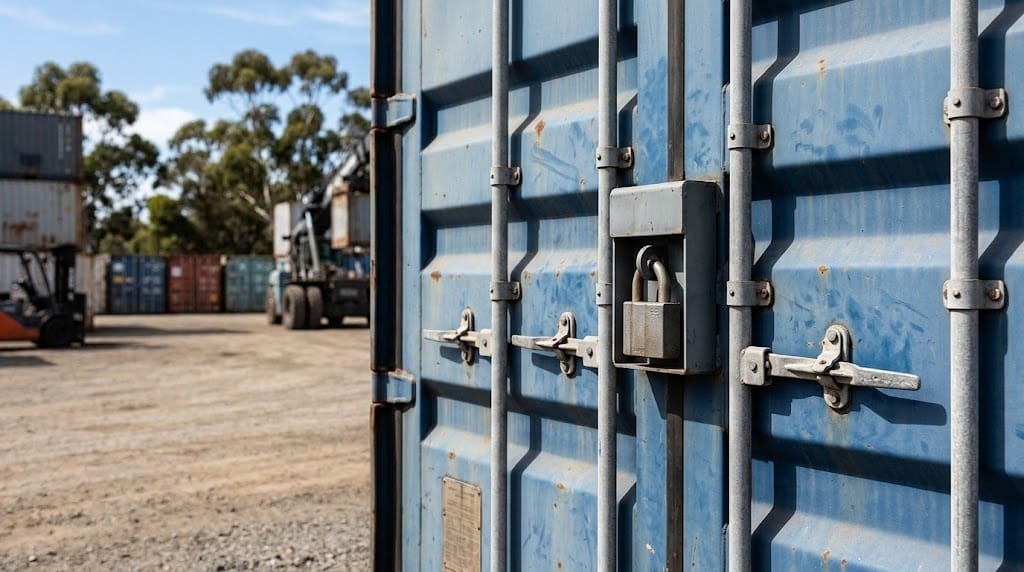
Hardened defence container doors use concealed hinges and reinforced locking bars that resist forced entry. These doors provide substantially greater resistance than standard container locking mechanisms – appropriate for secure ammunition storage containers and high-value defence equipment storage solutions.
Internal locking mechanisms protect against lock-picking and tool-based attacks. Hardened steel components provide security teams adequate time to respond to access attempts at remote sites.
Electronic access control systems track entry to containers for defence Australia deployments. Keypad or card-based systems create audit trails showing every access event – essential for secure ammunition storage containers where accountability prevents misuse.
Tamper-evident seals provide visual confirmation of any unauthorised access attempt. These numbered seals break if anyone opens the container, immediately alerting security teams to breaches in defence shipping container WA deployments.
Rapid Deployment and Transport Logistics
Defence operations require storage solutions that deploy within hours of arriving on-site. Military shipping containers Australia builds use ISO-standard dimensions that fit standard military transport configurations.
Corner casting twist-locks enable crane lifting and helicopter underslung transport. This capability is critical for reaching remote locations inaccessible by road – a common requirement for containers for defence Australia humanitarian response and forward base operations.
Plug-and-play power connections eliminate complex installation. Defence shipping container WA builds can arrive with pre-wired power leads matching standard generator connections. Technicians connect power, verify temperature settings, and have the unit operational in a short timeframe.
Self-contained systems reduce infrastructure requirements. Unlike permanent buildings requiring foundations, plumbing, and electrical installations, military-grade container modifications sit directly on level ground.
Temperature-Controlled Storage for Medical and Technical Equipment
Field hospital cold storage represents the most demanding refrigeration application in defence logistics. Vaccines, blood products, and certain medications require continuous 2°C-8°C storage. Temperature excursions outside this range can destroy entire medical stockpiles.
Containers for defence Australia configured for medical storage use digital temperature controllers maintaining tight accuracy. These controllers use dual sensors – one measuring air temperature, another monitoring product temperature – ensuring actual storage conditions match display readings.
Temperature data logging meets pharmaceutical cold chain documentation requirements. Built-in recorders capture temperature readings at regular intervals, storing data proving compliance with Therapeutic Goods Administration (TGA) storage standards during audits of field hospital cold storage facilities.
Battery backup systems protect against power failures during generator changeovers. A backup battery maintains temperature monitoring and alarm systems, alerting personnel to temperature excursions before medical products are compromised.
For remote containers for defence Australia medical deployments, our temperature monitoring and logging service provides continuous remote oversight – alerting designated personnel immediately if temperature parameters are exceeded.
Modifications for Specialised Defence Applications
Military-grade container modifications transform standard containers into specialised facilities beyond basic storage.
Workshop containers include integrated workbenches, tool storage, and power distribution. These mobile workshops support vehicle maintenance teams operating far from permanent bases.
Communications hubs in containers for defence Australia require climate control, cable management, and equipment racks. Purpose-built defence equipment storage solutions configurations house satellite communications gear, radio systems, and network equipment in climate-controlled environments.
Accommodation containers provide personnel shelter in remote locations. Insulated units with container air conditioning systems maintain comfortable temperatures whilst withstanding extreme weather conditions encountered across Australia’s diverse operational environments.
Secure ammunition storage containers demand explosion-proof electrical systems and enhanced ventilation. These builds use sealed lighting fixtures rated for hazardous areas and forced-air ventilation systems preventing propellant vapour accumulation.
Power Supply Solutions for Off-Grid Operations
Forward operating bases rarely access grid power. Defence shipping container WA builds must operate on generators, solar systems, or alternative power supplies.
A field operations power generator suits containers for defence Australia deployments running Carrier refrigeration units. It provides reliable backup power and can charge battery banks when emergency recharging is needed.
A field power connection adaptor converts generator output to match refrigeration unit requirements for military shipping containers Australia builds. This prevents the compatibility issues that arise when international-standard equipment connects to Australian power supplies in the field.
Field site extension leads rated for sustained refrigeration loads prevent voltage drop over distance at large defence shipping container WA deployments where power sources may be separated from container placement areas.
Maintenance and Reliability in Remote Locations
Equipment failures in remote locations create operational risks. Defence equipment storage solutions must operate for extended periods between maintenance visits.
Refrigeration units use industrial-grade compressors designed for sustained operation in demanding conditions. Accessible service panels enable field maintenance. Positioning refrigerant access ports, electrical connections, and control systems behind external panels allows technicians to service units without entering the container.
Our defence container field service covers maintenance and component replacement for containers for defence Australia throughout their operational life – including ARC-licensed refrigerant handling, electrical testing, and structural repairs.
Our structural compliance check ensures defence shipping container WA builds remain structurally compliant after extended operational service and between deployments.
Compliance With Defence and Safety Standards
Containers for defence Australia procurement requires compliance with Australian and international standards.
Container Refrigeration supplies defence shipping container WA and broader containers for defence Australia applications, with configurations matched to operational requirements and compliance standards. Our technical team reviews site conditions, power supply, and transport constraints before recommending specifications.
ISO 1496 certification proves containers withstand stacking loads, lifting forces, and transport stresses. This international standard ensures military shipping containers Australia builds survive military transport without structural failure.
Electrical systems in defence shipping container WA builds must comply with AS/NZS 3000. This includes proper earthing, circuit protection, and cable sizing – critical when containers operate unattended for extended periods.
Refrigerant handling requires Australian Refrigeration Council (ARC) licensing. All refrigeration work on containers for defence Australia must be performed by ARC-licensed technicians – ensuring legal compliance and maintaining system performance.
Field hospital cold storage and catering containers must meet Food Standards Australia New Zealand (FSANZ) requirements. This includes food-grade internal surfaces, proper drainage, and temperature control documentation.
Our pre-deployment unit inspection verifies that all defence shipping container WA refrigeration systems are fully operational, compliant, and ready for field deployment before handover.
Selecting the Right Container Configuration
Defence equipment storage solutions require matching container specifications to actual operational requirements.
Size selection depends on storage volume and transport constraints. A 10-foot defence shipping container WA build suits helicopter transport and smaller teams. 20-foot units balance capacity with standard truck transport. 40-foot containers for defence Australia maximise storage but require larger transport vehicles and cranes.
Temperature range determines refrigeration unit selection. Field hospital cold storage requires precise 2°C-8°C control. Secure ammunition storage containers need stable ambient storage rather than refrigeration. General electronics storage requires controlled temperature and humidity to prevent condensation damage.
Security requirements influence door and lock specifications. Sensitive secure ammunition storage containers and medical supplies demand heavy-duty security door modification and electronic access control – the same doors used for high-value field hospital cold storage protection.
Call (08) 9335 6299 or request a free quote to discuss your containers for defence Australia requirements. We’ll confirm the right configuration for your operational environment and compliance obligations.